Calculate VAT quickly and accurately with our free VAT calculator. Enter an amount, select the VAT rate, and instantly add or remove VAT from the entered amount. No registrations, no signups, free, forever.
How to Use the Free VAT Calculator
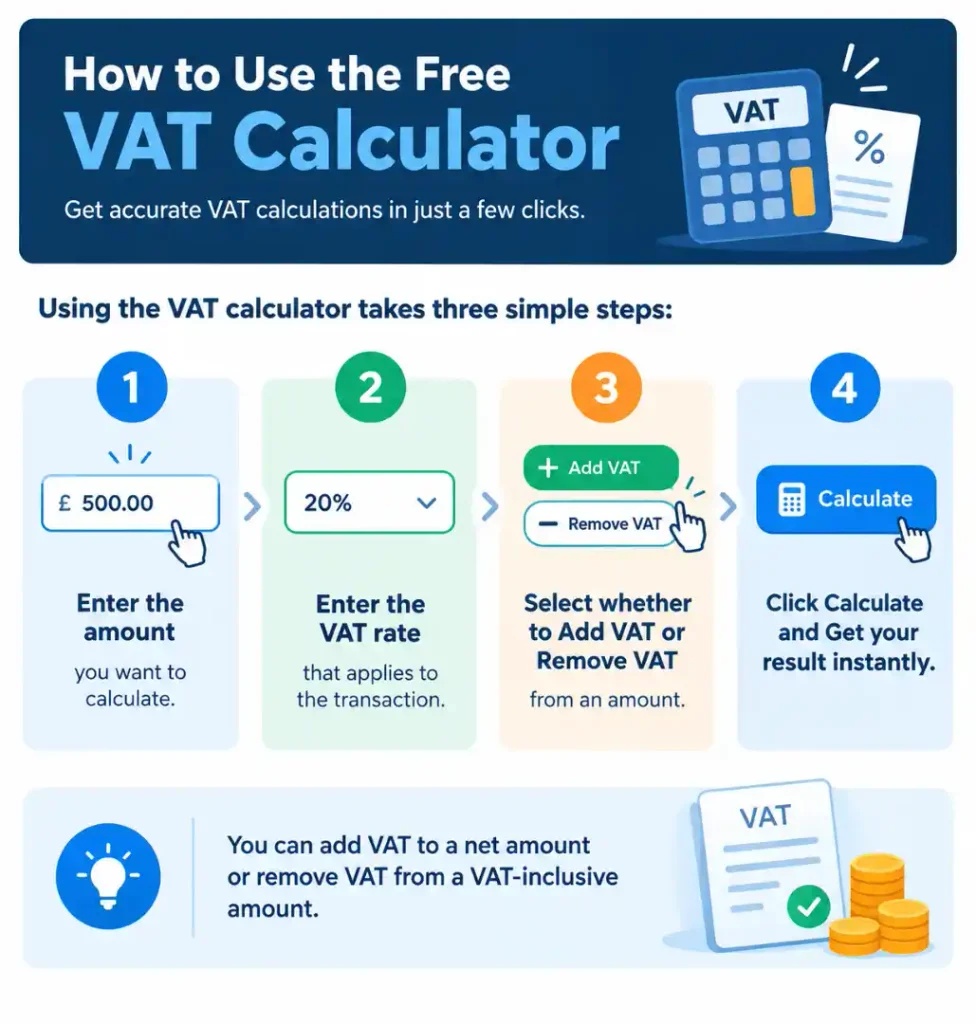
Using the VAT calculator takes three simple steps:
- Enter the amount you want to calculate.
- Enter the VAT rate that applies to the transaction.
- Select whether to Add VAT or Remove VAT from an amount.
- Click Calculate and Get your result instantly.
You can add VAT to a net amount or remove VAT from a VAT-inclusive amount.
Using the VAT Calculator
Enter any amount into the calculator and select Add VAT or Remove VAT.
Add VAT calculates the VAT-inclusive price from a VAT-exclusive amount.
Remove VAT calculates the VAT-exclusive amount and VAT portion from a VAT-inclusive price.
The Free VAT Calculator then displays the net amount, VAT amount, and gross amount so you can see the complete calculation at a glance.
How to Work Out VAT
At the standard UK VAT rate of 20%, adding VAT to a net amount is straightforward.
To add VAT:
Net amount × 1.20 = Gross amount
For example:
£500 × 1.20 = £600
The VAT amount is therefore £100.
To remove VAT from a VAT-inclusive amount:
Gross amount ÷ 1.20 = Net amount
For example:
£600 ÷ 1.20 = £500
The VAT amount is £100.
A common mistake is to simply subtract 20% from a VAT-inclusive price. To remove VAT correctly, divide the gross amount by 1.20 at the 20% rate.
How our Free VAT Calculator Works?
The calculator uses the VAT rate you select to calculate the VAT portion of an amount.
For VAT-exclusive amounts, the calculator adds VAT to produce the gross price. For VAT-inclusive amounts, it works backwards to determine the net price and VAT component.
You can change the VAT rate when the transaction uses a rate other than the standard rate.
Enter Amount
Enter the amount you want to calculate into the amount field.
The amount can represent a product price, service charge, invoice value, quotation, expense, or any other figure on which VAT needs to be calculated.
Choose Rate
Select the applicable VAT rate.
The standard UK VAT rate is 20%, while certain goods and services may qualify for reduced, zero-rated, or exempt treatment.
For international calculations, select the appropriate VAT or GST rate where supported by the calculator.
Get Results
After entering the amount and selecting the VAT rate, the calculator provides the result immediately.
You can see:
- Net amount excluding VAT
- VAT amount
- Gross amount including VAT
This makes the calculator useful for checking invoices, preparing quotations, pricing products, and verifying VAT calculations.
Why Choose Our Free VAT Calculator?
Supports All UK Rates
The calculator allows you to work with different VAT rates instead of assuming that every transaction uses the standard 20% rate.
Mobile Friendly
The calculator is designed to work on desktop computers, tablets, and mobile devices, allowing you to calculate VAT wherever you are.
Always Up-to-Date
VAT rates, thresholds, and tax rules can change. The calculator and supporting information should therefore be reviewed regularly to reflect current rules.
Simple & Intuitive
Enter an amount, choose a rate, and calculate. No complicated accounting knowledge is required for basic VAT calculations.
Save Time & Effort
The calculator performs the calculation instantly, reducing the need for manual calculations when checking multiple amounts.
Accurate Results
The calculator applies the selected VAT rate consistently to provide the net amount, VAT amount, and gross amount.
What are the features of our Free VAT Calculator?
Accurate Results
Calculate VAT quickly without manually applying formulas to every transaction.
Reverse Mode
Use reverse VAT calculations to determine the VAT-exclusive price from a VAT-inclusive amount.
Flexible Tax Rates
Select the appropriate VAT rate instead of being restricted to a single percentage.
Works without Internet
Where supported by the calculator application, calculations can be performed without an active internet connection.
Calculation History
Keep track of previous calculations where calculation history is available, making it easier to review recently calculated amounts.
13 Expert VAT Optimisation Tips
VAT management involves more than calculating the VAT on an invoice. Businesses can also improve their VAT processes by reviewing expenses, records, accounting methods, and reclaim opportunities.
Top 4 Missed VAT Reclaims That Could Save You £332/y
1. Mobile phone bills:
Where a mobile phone is used for business purposes, the business-related portion may qualify for VAT recovery when the relevant conditions and documentation are met.
2. Home office costs:
Businesses operating from home may be able to recover VAT on qualifying business-related costs where VAT has been charged.
3. Mileage:
VAT recovery may be available on the business-use element of qualifying fuel costs when appropriate records and receipts are maintained.
4. Professional subscriptions:
Trade memberships, professional publications, and other business-related subscriptions may qualify for VAT recovery where the relevant requirements are satisfied.
5. Open a Separate VAT Bank Account
Keeping money set aside for VAT can make VAT payment dates easier to manage. Separating VAT-related funds from ordinary working capital can also provide a clearer view of available cash.
6. Claim Pre-Registration VAT on Your First Return
Businesses that register for VAT may be able to reclaim certain VAT incurred before registration, subject to the applicable rules, time limits, and conditions.
7. Review Your Flat Rate Percentage Annually
Businesses using the Flat Rate Scheme should review whether the applicable percentage remains appropriate as their activities change.
The Flat Rate Scheme has specific rules, including provisions affecting limited-cost businesses, so professional advice may be appropriate where the position is unclear.
8. Time Major Purchases Strategically
Large purchases can involve significant input VAT. Planning purchases and maintaining the correct VAT documentation can help businesses manage VAT recovery and cash flow.
9. Use Cash Accounting if You Have Slow-Paying Clients
The Cash Accounting Scheme can allow eligible businesses to account for VAT based on payments received and made rather than simply relying on invoice dates.
This can be useful for businesses that regularly deal with slow-paying customers, subject to scheme eligibility.
10. Always Use Postponed VAT Accounting on Imports
Eligible VAT-registered businesses can use Postponed VAT Accounting (PVA) for qualifying imports. PVA can help businesses account for import VAT on their VAT return rather than paying it immediately at the border, subject to the relevant customs requirements.
11. Reclaim VAT on Bad Debts Proactively
Businesses may be able to claim bad debt relief when the relevant conditions have been met. Keeping unpaid invoices under review can help prevent eligible claims from being overlooked.
12. Check Supplier VAT Numbers on HMRC’s Website
Before reclaiming VAT, make sure the supplier is properly VAT registered and that the invoice contains the required information.
Checking supplier VAT details can be particularly useful for significant purchases or transactions involving new suppliers.
13. Get an Annual VAT Health Check
A periodic VAT review can identify calculation errors, missed recovery opportunities, incorrect VAT treatments, and record-keeping problems before they become larger issues.
13 VAT Mistakes That Cost Small Businesses Thousands
1. Charging the Wrong VAT Rate
Not every taxable supply is subject to the standard VAT rate. Businesses should check whether goods or services are standard-rated, reduced-rated, zero-rated, exempt, or outside the scope of VAT.
2. Claiming VAT Without a Valid Invoice
Input VAT recovery generally requires appropriate VAT documentation. Businesses should retain invoices containing the information required by the VAT rules.
3. Mixing Business and Personal Expenses
Where an expense has both business and private use, the VAT recovery may need to be restricted to the business element.
4. Relying on the Wrong Flat Rate Percentage
Businesses using the Flat Rate Scheme should ensure that the correct percentage is applied to their circumstances and business activity.
5. Forgetting to Account for VAT on Goods Taken for Personal Use
Where business goods are taken for private use, the VAT treatment should be considered rather than assuming that the original business purchase automatically remains fully recoverable.
6. Not Understanding the Time of Supply
The tax point determines which VAT period a transaction belongs to. Businesses need to understand the applicable rules for goods, services, invoices, and payments.
7. Not Reclaiming VAT on Capital Purchases
Large business purchases can contain significant amounts of recoverable input VAT. Proper records and correct VAT treatment are essential.
8. Missing the Bad Debt Relief Window
Eligible businesses should monitor unpaid invoices and make bad debt relief claims within the applicable time limits.
9. Paying for Business Expenses Personally Without Claiming
Where an employee or business owner pays a legitimate business expense personally, the business should retain the appropriate VAT documentation and account for the expense correctly.
10. Not Issuing Credit Notes Correctly
When an invoice is reduced, cancelled, or refunded, the VAT records should be adjusted correctly and an appropriate credit note issued where required.
11. Claiming VAT on Client Entertainment
VAT recovery on entertainment expenses depends on the circumstances. Client entertainment is treated differently from qualifying staff entertainment.
12. Not Keeping Records
VAT records need to be retained for the required period. Businesses should maintain appropriate backups when changing accounting software or accountants.
13. Filing Late Because You Cannot Afford the VAT Bill
A business should not simply ignore a VAT return because the payment cannot currently be made. Filing obligations and payment arrangements are separate issues, and businesses facing cash-flow difficulties should contact HMRC promptly.
Do You Need to Register for VAT?
VAT registration depends on taxable turnover and the applicable registration rules.
Businesses should monitor their taxable turnover continuously rather than waiting until the end of a financial or tax year.
The 30-Day Forward-Looking Rule
Businesses may also need to register when they expect taxable turnover to exceed the applicable threshold within the relevant future period.
This makes accurate forecasting important, particularly when a business is about to enter a large contract or receive a significant order.
The Exception That Could Save You
Certain businesses with a temporary or exceptional increase in turnover may be able to apply for an exception to registration where the relevant conditions are satisfied.
Because VAT registration rules can have significant financial consequences, businesses should check the current HMRC requirements before relying on an exception.
VAT Rates: The Cheat Sheet
| VAT treatment | Typical description |
| 20% | Standard rate |
| 5% | Reduced rate for qualifying goods and services |
| 0% | Zero-rated supplies |
| Exempt | Supplies outside the normal VAT charging mechanism |
The applicable treatment depends on the specific goods or services and the circumstances of the transaction.
Why Zero-Rated ≠ Exempt
Zero-rated and exempt supplies are not the same.
Zero-rated supplies carry VAT at 0%, but remain within the VAT system. This can allow related input VAT recovery where the normal requirements are met.
Exempt supplies do not have VAT charged on the supply, and input VAT recovery can be restricted.
This distinction can have a significant financial impact on a VAT-registered business.
The Bizarre Classifications
UK VAT contains detailed rules covering specific products and circumstances. Some classifications can appear unusual because the VAT treatment depends on precise legal definitions.
Businesses should therefore check the VAT treatment of a specific product or service rather than relying only on its everyday description.
Global VAT Rates Compared
VAT and similar consumption taxes vary significantly between countries.
The United States, for example, does not operate a federal VAT system; sales taxes are generally imposed at state and local levels.
Other countries use VAT or GST systems with their own rates, registration thresholds, exemptions, and reporting requirements.
International businesses should always check the rules applicable to the country where the supply takes place.
FAQs
Can I reclaim VAT on a car?
VAT recovery on cars depends on how the vehicle is used and the specific VAT rules that apply. Different rules can apply to cars, commercial vehicles, leases, and vehicles used entirely for business.
Do I charge VAT when doing business outside the UK?
The VAT treatment depends on the type of supply, customer location, and applicable place-of-supply rules. Exports and international services can have different VAT treatments.
What happens if I deregister?
Once VAT deregistration takes effect, a business normally stops charging VAT from the effective deregistration date and may need to submit a final VAT return.
Can I backdate a VAT claim?
Certain VAT claims and adjustments can be made retrospectively, but the applicable time limits depend on the type of claim.
Is voluntary registration worth it below the threshold?
There is no single answer for every business. The effect can depend on whether customers are businesses or consumers, the amount of input VAT incurred, pricing, and administrative costs.
What is a valid VAT invoice vs a receipt?
A VAT invoice contains specific information required by the VAT rules. A payment receipt does not necessarily contain all the information needed to support an input VAT claim.
Can I reclaim VAT working from home?
VAT recovery may be available on qualifying business-related costs, but the treatment depends on the expense, VAT charged, business use, and applicable rules.
How do I fix VAT errors?
The method for correcting a VAT error depends on the size and nature of the error. Some errors can be corrected on a subsequent VAT return, while others need to be reported separately.
Do I have to charge VAT before my VAT number arrives?
VAT obligations can apply from the effective date of VAT registration rather than simply the date on which the VAT number is received. Businesses should follow the effective date stated by HMRC.
What software do I need for Making Tax Digital?
VAT-registered businesses within Making Tax Digital requirements generally need compatible software for maintaining digital records and submitting VAT returns.
About This Free VAT Calculator
This free VAT calculator is designed to calculate VAT on invoices, receipts, purchases, sales, and other amounts.
Enter an amount, select the applicable VAT rate, and calculate the VAT instantly. You can add VAT to a net amount or remove VAT from a gross amount.
The calculator can also be useful when checking different VAT rates or working with international VAT and GST calculations.
History of VAT
Value Added Tax (VAT) was introduced in the UK in 1973 as a replacement for Purchase Tax.
The standard UK VAT rate has changed over time. The standard rate increased from 17.5% to 20% on 4 January 2011.
VAT has since become one of the UK’s major sources of government revenue.
VAT rules, rates, thresholds, and reporting requirements can change. Always check the latest guidance from HM Revenue & Customs (HMRC) or consult a qualified tax professional when dealing with a specific tax position.
Disclaimer: This free VAT Calculator and its VAT guides are provided for general informational purposes and should not be treated as professional tax advice. Always verify the current VAT rules, rates, thresholds, and eligibility requirements with HMRC or a qualified accountant.